
In 2003 we started keeping a diary of sorts, recording our journey through CPT
We were a few months before our 40th birthday, nonsmokers and in good health, when our symptoms first started. Although we did not experience chest pain, we did have episodes of dizziness and a "crackling sound" upon inhalation. Symptoms would last a few days, resolve and then return later. We did not correlate the symptoms to the onset of menses at that time.
Prior to this little adventure, we were both on birth control pills, prescribed for painful menstrual periods. Lynn experienced shortness of breath when the crackling sound returned in Dec 2002. Due to a throat infection one week prior, she thought she might have bronchitis and went to the doctor for an evaluation. A chest x-ray showed a 90% pneumothorax. The doctor called for an ambulance. She had a chest tube inserted in the ER and spent four days in the hospital.
One month later and back to work, Lynn became light headed and experienced yet another exciting ride in the ambulance! An x-ray showed a 20% re-collapse. Both collapses had occurred at the start of her period. Being made aware, (after the first collapse) of a type of pneumothorax associated with menses, we thought it too coincidental. Although Lynn was never diagnosed with pelvic endometriosis, twin sister Lori was and both shared all the same symptoms. Gratefully, the surgeon was aware of the condition. He provided the name as catamenial pneumothorax, and sent Lynn home with a Heimlich valve chest tube (a one-way valve that lets air out of the pleural space, but not back in).
After one week the collapse did not resolve and the pulmonary specialist suggested chemical pleurodesis (the standard treatment for reoccurring SPT). After reading about CPT, we knew that pleurodesis alone in such cases showed a high rate of re-collapse, because it does not address the hormonal cause. When this was suggested to the pulmonary specialist, he flatly dismissed the possibility, because the condition was so rare.
Lynn refused the pleurodesis and spoke to her doctor about surgical options. Gratefully, he was much more open to the idea, and she was referred for surgery. During VATS, the surgeon found and sutured holes in the diaphragm. He also found scar tissue which he felt, indicated past smaller collapses which had resolved by themselves. He performed the pleural abrasion with talc. Lynn spent twelve days in the hospital.
The Pneumothorax Twins
During all of this, and for the few months prior, Lori had been experiencing episodes of lightheadedness, off and on. She thought it was due to the massive bleeding she had been experiencing after receiving an injection of Depo-Provera (about nine months prior for endometriosis).
In March of 2003, the dizziness got very bad and she went into an Urgent Care facility. After explaining to the doctor that she wanted an x-ray to rule out a pneumothorax, he said that she had good breath sounds and good blood oxygenation and refused to give her one. A few days later she was back and again asked for an x-ray, which showed a 60% collapse. She was transported to the hospital ER, declined a chest tube and requested to speak to the thoracic surgeon. Two days later, Lori underwent VATS, and her surgeon also found holes in the diaphragm. He repaired the holes and performed pleural abrasion.
We are still in the process of recovering. Breathing is still at times a bit labored (two months from surgery), but is getting better every day. We still have some pain (from the chest tubes), mostly a sporadic stinging kind of pain under and along the inside of the right breast. There is still numbness there as well.
Overall recovery is going well, and we feel more back to normal each day. We have a new appreciation for just being able to breathe without having to think about it! We have learned a lot along the way, and were blessed to be cared for by some really wonderful doctors, nurses and hospital staff.
Six Month Update
Following surgery, we were put back on birth control pills. Lori experienced increased blood pressure and discontinued use, while Lynn continued to take them. Shortly after our original post, we both experienced a re-collapse. Lori had a 15% which resolved unassisted after three weeks. Lynn had a 15% which increased to a 30% after three weeks. Lynn was readmitted to the hospital for another chest tube and the chemical sclerosing procedure (a very painful, but survivable experience). As the birth control pills were ineffective in controlling the endometriosis, the OB-GYN recommended Lupron (a GnRH analog) or a hysterectomy/oophorectomy.
Knowing the ineffectiveness of Lupron to resolve endometriosis long term (because it can't be taken indefinitely), and aware of the significant side effects Lori continued to suffer from after Zoladex and Depo-Provera, we began to research other options. We had our hormone levels evaluated, and obtained a prescription for bioidentical progesterone. After six months of this therapy, we had not had any more large collapses but continued to experience episodes of what can be described as "bubbles moving around", or small collapses.
In spite of that, we did note that our pelvic endo symptoms decreased somewhat. Lori's excessive clotting during menstruation lessened and her periods were becoming more regular. (After the Depo-Provera she bled almost daily for about ten months, sometimes with heavy clotting.) The fibroids and pelvic implants had decreased a bit in size and also in the intensity of pain during menstruation. As for the chest, shoulder and back pain associated with collapses, that had decreased as well. It was still there but to a lesser extent than it was, and it was more sporadic. It was not the constant sharp pain that it had been.
As we continued this therapy, our progesterone levels had risen to levels allowing better balance with the estrogen. We had also since learned that we had iron deficiency anemia, and were very high in cortisol. Both of those problems are interconnected with our endo problem. In addition to the progesterone, we started taking iron supplements, vitamins and a cortisol inhibitor. Overall, we did feel a little better. We had less pain even with the small collapses.
In spite of the progress, Lynn experienced a 40% re-collapse in January 2004. She had another chest tube and more talc inserted. During her hospital stay, she had a total abdominal hysterectomy with removal of both ovaries as well (oophorectomy). The doctor said that her pelvis was "a mess," with multiple fibroids and endometrial adhesion everywhere. Both ovaries were completely covered in dried blood, and one fibroid was nearly as large as her uterus. Lori is currently scheduling the same surgery for April 2004.
Despite our best efforts to avoid this surgery, we had been left with few options. We are hoping that this will finally allow us to move forward with our recoveries. Due to the estrogen-dependence of the endo implants, we will not be using hormone replacement therapy, and will address post-menopausal symptoms with natural substances which do not contain estrogen.
December 2004 Update
Lori is 8 months post op and has had no further collapses since her oophorectomy. During her recovery, her stored iron level (ferritin) has increased a few points. Although she continues to have episodes of pounding heart, (especially at the end of a stressful day), it has decreased in frequency from where it was at the diagnosis of anemia. She is currently taking Proferrin, a heme-iron supplement (Colorado Biolabs). Her energy is slightly better, but she also continues to experience episodes of fatigue accompanied by increased blood pressure. The lower estrogen has contributed to hot flashes and joint pain, especially in her hands. Glucosamine, evening primrose, fish oil and vitex have helped to reduce the severity of symptoms but have not eliminated them.
Although it was not our original intention, Lori has started on estrogen therapy. She is taking Tri-Est, a bioidentical estrogen cream, containing mostly estriol. She is also using bioidentical progesterone. In the last month, she and her doctor have been adjusting the dosage of both, in an attempt to restore some level of estrogen/progesterone balance without causing the endometriosis to proliferate. Posts on the Hystersisters web site indicate that many women with a history of endometriosis, can experience some relief of menopausal symptoms using bioidentical estrogen/progesterone without having the endometriosis return. Due to past issues with synthetic progestins, Lori will be using bioidentical hormones.
Lynn is 11 months post op and is feeling much better. She also has had no further collapses since her oophorectomy. During months 1-6, she was somewhat weak and tired, but started to feel almost normal after about 6 months. At 11 months, she feels even better. Shortly after the oophorectomy, she had limited chest/back pain, which has decreased substantially over time. We feel that any residual pain seems to be more from scar tissue resulting from surgery/pleurodesis, as it is not in the same place or of the same type as when we experienced pain during collapses. Her breathing has improved and she notices that muscles in her back and around her lung seem to "loosen up" after moderate exercise. In the early months after the oophorectomy, Lynn had hot flashes and night sweats, but continues to experience only mild hot flashes now. She is taking evening primrose, some progesterone and avoiding products containing soy. She did experience some weight gain following surgery, although considering the change in hormone levels and the trauma of surgery it is not unreasonable to attribute this to an increase in cortisol. A cortisol reducer and moderate exercise are helping to keep her weight under control. Overall, Lynn is feeling pretty good and has resumed all normal activities.
Goals for 2005
Lynn will not be taking estrogen, but Lori will continue to, so that we can compare menopause symptoms and monitor Lori for any return of endometriosis or CPT symptoms.
Another goal we have is to compile the experiences of all of you who have written to us, so that you can review the treatment trends of a larger group of patients, besides just the two of us.
This would probably take the form of a questionnaire and the results would be posted on a new survey page. We are in the process of determining the best way to do that. Your identity, of course, would be confidential, and known only to us. Both your answers to the questions and your e-mail address would also be confidential. Your responses would be used only in a statistical format; (for example, "40% of respondents (52) had VATS", etc.) We will contact you by e-mail when the survey is ready. You may also contact us, to express your interest or disinterest in participating. We will keep you posted in the new year as we continue to look for answers together!
November 2006 Update
We have delayed updating our conditions due to Lori's continued health problems, which have now hopefully, been resolved with the removal of her right kidney in October of this year (more on that later). First off though, we are happy to report that we have had no further collapses since our oophorectomies in January and April of 2004. (Lori did experience a minor collapse during her kidney surgery which was expected and is explained below). We are now both taking low doses of bioidentical estradiol and testosterone and a higher dose of bioidentical progesterone, and have had no problems with this type of hormone replacement therapy. All three hormones are applied as a topical transdermal cream. The bioidentical HRT has decreased our menopause symptoms of hot flashes and joint stiffness. We are also taking extra calcium, SAM-e and a thyroid support supplement (not thyroid hormone). Lynn feels good, has energy and reports that even the scar tissue discomfort has lessened over time. She has also flown several times across the US, with no problems. Lori is slowly regaining her energy back since her kidney surgery.
As for Lori's kidney issues, following her thoracic surgery she never fully regained her health. Her blood pressure had been elevated during the use of Depo-Provera and Zoladex, but in the last two years it continued to spike periodically. At times it would be normal and then rise into the 180's for no apparent reason. She began to experience symptoms of dizziness, heart pounding, heart palpitations, muscle weakness and fatigue. As her condition deteriorated, she stopped driving, and could not stand for more than a few minutes. Her equilibrium was off to the point where she constantly felt like she was on a boat or on an elevator. Her primary care physician remained unconvinced that anything was wrong with her and continued to prescribe blood pressure medications. We pursued numerous would-be causes on our own and had her evaluated by several doctors (heart, thyroid, parathyroid). Finally we paid for a CT scan ourselves which showed that one of her kidneys had atrophied while the other had enlarged. At some point, the artery to the right kidney had become blocked, causing the kidney to overproduce renin. As part of a feedback mechanism, renin constricts the blood vessels, thereby raising the blood pressure and causing more blood to be delivered to the kidney. This rise in blood pressure is system wide, which may explain why Lori reported that she always felt "buzzy". After more investigation on our part and a lack of action on the part of her health plan, she referred herself to UCLA, and was seen by an expert in Renal Artery Stenosis. After evaluating both renal arteries, he determined that the left was perfectly clear, but that the right artery could not be repaired and that the right kidney could not be saved. In October 2006, she underwent a laparoscopic right nephrectomy, and now finds that her blood pressure is stable without any medication. Her energy is slowly returning, the palpitations have stopped and she is feeling better. We expect a full recovery.
We share this latest development with you because during a laparoscopic procedure, a significant volume of carbon dioxide gas is inserted into the abdominal cavity so that the surgeon can better view the organs. Because Lori's diaphragm was compromised, we knew that the gas pressure on her diaphragm could be a problem, and so we discussed this concern with her surgeon. We all agreed that in a worse case scenario, she would wake from surgery with a chest tube. As it turned out, she did in fact experience a small collapse (5%) that required a Heimlich value chest tube. The carbon dioxide evacuated by the following day, and the back pain from the collapse went away. We mention this especially for the CPT ladies who are considering a laparoscopic hysterectomy/oophorectomy. You should be aware of this possibility during any laparoscopic procedure, and be sure that your surgeon knows that you could experience a pneumothorax during surgery.
We are pleased with our recoveries and hope that our story will give you information, a new perspective and HOPE!
January 2008 Update
It has now been five years since our CPT adventure began, and we continue in good health. We have remained collapse-free since our oophorectomies in 2004. Lori has recovered from her nephrectomy in 2006 and her blood pressure remains stable. We continue to take bioidentical pharmacy-compounded transdermal HRT and are doing well. In our efforts to keep the estrogen low and the progesterone balanced, our current dosages are: Estradiol: Lori - 3 mg / daily; Lynn - 1 mg / daily; Estriol: Lori - 3 mg / daily; Lynn - 1 mg / daily; Testosterone: Lori - 1 mg / daily; Lynn - 1 mg / daily; Progesterone: Lori - 150 mg / daily; Lynn - 100 mg / daily.

Other supplements and vitamins include calcium (1000 mg / day), multivitamins, fish oil, probiotic, cranberry and thyroid support (not thyroid hormone). Lori continues to take the Proferrin (Heme iron supplement).
New to the web site, we have added a CPT Fact Sheet for ladies to take to their doctors, in lieu of printing the web pages. See FACT SHEET for Doctor to download the two page pdf document. [2016 update: The Fact Sheet has been moved to the What is CPT? page]
We have also updated the survey and made it available on-line. Working with SurveyMonkey.com has enabled us to make the survey easier to complete. If you are a CPT patient, we would really appreciate your participation. Just visit the Survey Page to access the link, or send us an e-mail and we will send the link to you.
[2016 update: The survey is now closed but you can review the results on the Survey page]
Although we continue in good health, we faced other challenges this last year which proved to be even more difficult than our struggle with CPT.
In November 2006, just 30 days after Lori's nephrectomy, our healthy mom of 61 was diagnosed with cloacogenic carcinoma, a rare and aggressive form of anal cancer. After receiving a clear routine colonoscopy exam just three months prior, she began to experience symptoms of an obstructed bowel, which her physician promptly diagnosed as irritable bowel syndrome (IBS). Eventually the pain worsened, sending her to the emergency room. A non-operable rectal tumor causing a bowel obstruction was discovered and an emergency colostomy was performed (re-routing of the bowel).

For the next several months we traveled often between Los Angeles and San Diego to accompany mom through chemotherapy, radiation, multiple hospitalizations, surgeries and other procedures. During this time, our dad, who had previously depended upon mom for everything, had to learn how to completely manage the household as well as function as the primary caregiver. To his credit, he faced a very short learning curve and accomplished more than even he thought he was capable of. Knowing that time with her might be short, we worked to improve the quality of her life where we could and found ways to show her how much we loved her. The Lord blessed us with 7 months before gently calling her home in June 2007.
Struggling through this journey with mom was incredibly painful and emotionally exhausting. We now know how she felt watching us go through CPT; wanting to stop the suffering and being helpless to do much about it.
Had we not had our strong faith in the sovereignty of God, we would have fallen to pieces long ago. Although we begged him for her healing, he chose not to heal her here. While this was not the outcome we had prayed for, his intervention was clearly demonstrated in many other ways by providing emotional, financial and logistical resources just when we needed them. Knowing we are held by God, gave us strength to accompany mom through her ordeal and continues to give us strength as we face our futures without her.
Although the loss is great, we look forward to the day when we will see her again, and we are comforted to know that she is finally free, safe and whole. Life can be incredibly hard, but God is faithful.
"But those who hope in the Lord will renew their strength. They will soar on wings like eagles; they will run and not grow weary, they will walk and not be faint." Isaiah 40:31
July 2010 Update
Life has been very different since we lost our mom three years ago. God, however, has continued to sustain us through this time and we have learned a great deal about his provision.
As we have walked the journey of grief, he has given us comfort and encouragement. Adjusting to a "new normal" has not been easy, but he has taught us truths about his love and sovereignty that we could not have learned otherwise. He has also given us the strength to write about our family's story, to help others who might be traveling the same road of suffering or loss.
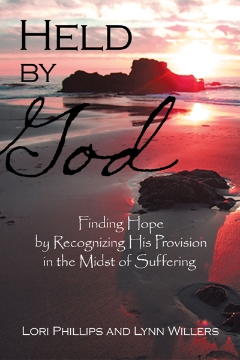
We are pleased to announce that Held by God: Finding Hope by Recognizing His Provision in the Midst of Suffering was published in June 2010. The book covers our struggles with catamenial pneumothorax, and our mom's journey through cancer. Written in a conversational style, we describe the tangible and practical ways that God met us where we were, and how those encounters helped us to maintain hope, despite the hardships. Interwoven throughout the narrative are the biblical stories of King David, the Apostle Paul, and Job, among others, demonstrating the unchanging character of God, and the consistency of his faithfulness.
You can find more information, watch the book trailer and access links for purchasing at HeldbyGod.com. It is our hope that you will find the book interesting, informative and inspirational as you face your own struggles.
March 2012 Update
We are happy to report that we continue to be collapse-free since our oophorectomies in 2004. Lynn continues to use pharmacy-compounded bioidential transdermal cream HRT in the following amounts: Estradiol: 2 mg/day; Estriol: 2 mg/day; Testosterone: 2 mg/day; Progesterone: 25 mg/3 days. After consulting with her doctor, she and he both agreed that too much progesterone could inhibit the beneficial effects of estrogen, and that given the amount of time since her oophorectomy, it was unlikely that decreasing the progesterone would allow endo growth to return. Since lowering her progesterone dose, she has not experienced any recurring symptoms of endometriosis or CPT.
Lori has been receiving implanted bioidentical hormone pellets since November of 2010 and has been doing well on that regimen. Although her first few procedures were under the Sottopelle program, she now works with her own gynecologist who is trained to provide the same type of HRT. The pellets contain estradiol and testosterone, and are inserted into the hip area about every three months. Lori works with her doctor to adjust the levels of hormones within the pellets based upon the degree of her menopausal symptoms. Initially she started at 22 mg of estradiol and 100 mg of testosterone (for three months), and is now at 30 mg estradiol and 75 mg testosterone. She is no longer taking any progesterone for the reasons stated above, and has also experienced no recurring endo/CPT symptoms.
Aside from slight menopausal symptoms, (and getting older which we can't do much about!) we are in pretty good health, despite our past medical challenges.
May 2014 Update
First off, we are happy to report that we remain collapse-free since our oophorectomies in 2004. We've learned a few things over the last two years that might be helpful to pass along.
In 2010, as mentioned above, Lori began using HRT pellets, while Lynn continued to use bioidentical transdermal creams. Over the course of about 35 months, Lori found that while she was able to obtain higher blood levels of hormones using the pellets, the release of hormones seemed inconsistent, causing widely fluctuating blood levels. Sometimes she felt that her menopausal symptoms were well controlled and at other times, not so much. Pellets work wonderfully for many people but in Lori's case, she felt that some pellets dissolved too fast and others too slowly, releasing either too much or too little hormone.
However, we did learn something useful related to CPT during her experience with the pellets. In trying to adjust the pellet dosage, Lori overshot the optimal blood level for estradiol. Not only did she experience symptoms like morning sickness, but her blood test results showed a level of over 800 pg/ml! Considering her history of endometriosis, this level of estradiol was very alarming. However the good news is, that even at this very high level, she had no returning symptoms of endometiosis or CPT.
This reiterates the importance of going without estradiol replacement for a time after an oophorectomy. Had Lori not refrained from using HRT after surgery, we wonder if this accidental high dose of estrogen would have regenerated any remaining endometrial tissue. Lori is now back on pharmacy-compounded bioidentical HRT transdermal creams and is doing fine.
One more note about the pellets: Just because Lori didn't have great success with HRT pellets, doesn't mean they don't work. In fact, the only CPT patient we know of whose collapses completely stopped, and who continues to menstruate without any monthly chest pain, is still on the Sottopelle pellet program. In her case, it looks like they were able to balance her hormones with testosterone, which has allowed her to remain collapse-free for several years now. Had we known about the program before our oophorectomies, it certainly would have been a better choice.
Since our oophorectomies, our thyroids have been working less than optimally, and we have had symptoms of hypothyroidism, which seems to be fairly common among menopausal women. In the last several months, we have been on Armour thyroid (natural desiccated thyroid). This change has made a big difference in how we feel. We have less fatigue, more stamina, and our eyebrows are beginning to grow back in!
While researching issues of hypothyroidism, we learned a lot about adrenal fatigue and how important the adrenals are to optimal thyroid function and hormone health. Healthy thyroid and adrenal glands are vital to feeling well, but are affected by repeated stress and trauma. Supporting the adrenals is always important, but especially necessary when undergoing any kind of stress, like surgery. The adrenal glands run on vitamin C and salt. Now a word about salt: processed table salt is indeed bad for your health, and that is why salt gets a bad rap. However, natural, unrefined, unprocessed salt contains trace minerals that are vital to many body functions. We prefer the pink Himalayan salt, but others include Celtic salt, and mineral salt. For a wealth of information on the thyroid, adrenals and related topics, visit Stop the Thyroid Madness web site.
Over the last eleven years since our CPT adventure began, we've done a lot of research and learned a lot about the interconnectivity of body systems. Probably one of the most important points is that when health is not optimal, the cause is generally not just one thing that goes awry. And when one thing isn't working right it frequently affects something else, and so on, so that several issues need to be addressed before one can experience better health. We've learned that thyroid function, hormone function, adrenal function, as well as levels of iron, intake of vitamin C, unprocessed salt, magnesium, and other minerals all work together as a team, to maintain optimal health.
We hope this update finds you well, and if you are a CPT patient, we wish you good health!
January 2016 Update
In December of 2015, the CPT web site got a much needed face lift! When we created the site in 2002 we used a program that is now mostly unsupportable. It was a huge project to move all of the content over to a new host, but the information is better displayed and the site is also now mobile-friendly. During the transition, we also added 20 new citations to the literature page, and updated the Doctor Fact Sheet on the CPT description page.

While we have established 301 Redirects from our old page urls, if you have bookmarked those pages, you should update them with the new page urls.
Another huge project we completed in the fall of last year was the republication of our book, Held by God. Originally released in 2010 by CrossBooks, the book was updated, re-branded and released in October by WestBow Press, a division of Thomas Nelson and Zondervan.
The book's web site has also been updated and reviews, purchase links and the book trailer can be found at HeldbyGod.com. To download a free pdf version, click here.